
Every stage carries an environmental cost. A cartridge that prints beautifully but ends up in a landfill after one use tells a different story than one that gets remanufactured five times before retiring.
Your real decision isn't "green versus not green." It's finding supplies that cut waste and resource use while still matching your printer, meeting your quality and page-yield needs, and fitting your budget and workflow.
This guide compares remanufactured, compatible, refillable, recycled-content, and biodegradable cartridge options, then closes with a practical checklist for purchasing and disposal.
Key Takeaways
- "Remanufactured," "recycled," "refillable," and "biodegradable" name different processes—not the same product.
- The most sustainable cartridge fits your printer, hits expected yield, and gets returned or recycled.
- Toner (laser powder) and ink (inkjet liquid) bring different performance and waste tradeoffs.
- Verify composition, testing, recycled content, and take-back programs before you buy.
- Duplex printing, draft mode, and recycled paper cut impact further—whatever cartridge you use.
- Impression Products took Lexmark to the U.S. Supreme Court in 2017 and won — the ruling that makes remanufactured Lexmark cartridges legal to buy and sell nationwide
What Makes a Toner or Ink Cartridge Eco-Friendly?
A cartridge's environmental footprint spans seven stages: raw-material extraction, manufacturing, packaging, transport, use, replacement, and disposal. A single "eco" feature, like recycled plastic in the housing, doesn't tell you much about the other six stages.

Terms That Get Confused (But Shouldn't)
Suppliers throw around sustainability language loosely. Each term means something different:
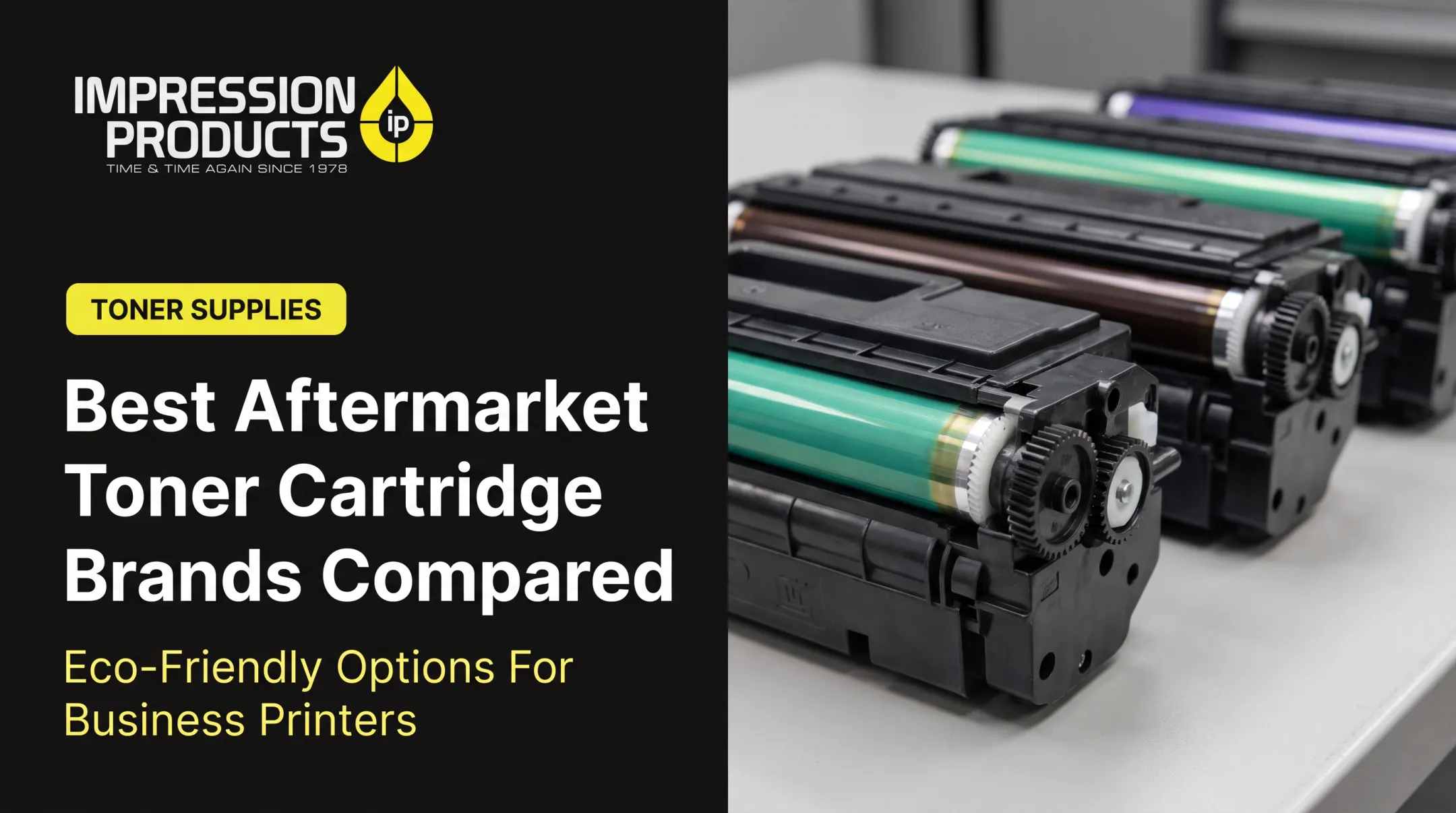
- Remanufactured – A used cartridge is collected, cleaned, inspected, rebuilt with new wear components as needed, refilled, and tested for reuse.
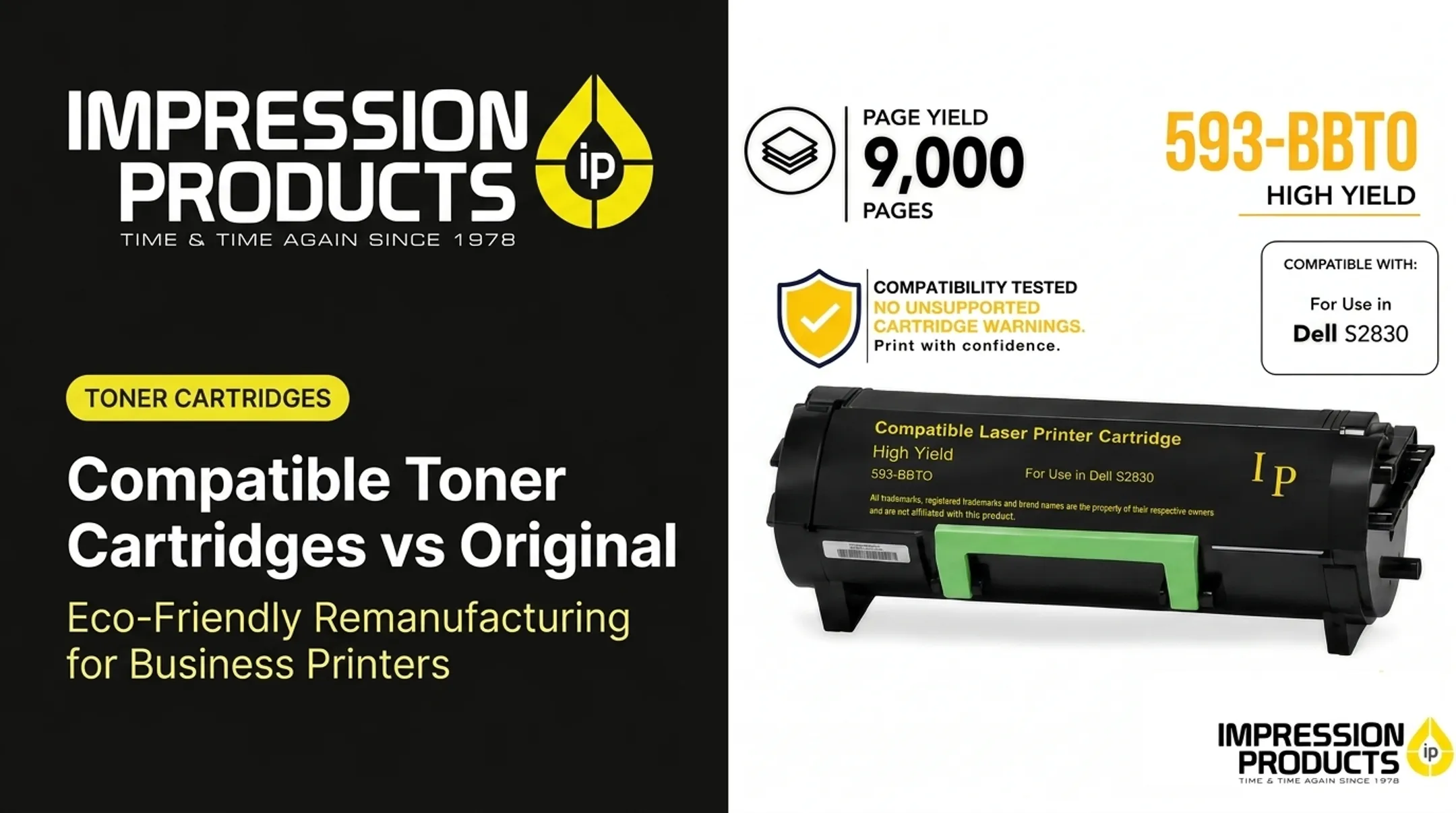
- Compatible – A newly produced, non-OEM cartridge engineered to work with a specific printer model or family. New production, not reuse.
- Recycled-content – The cartridge or its components contain material recovered from manufacturing scrap or postconsumer waste. This describes content, not full recyclability.
- Refillable – A system designed for replenishment rather than disposal after one use, such as an ink tank you top off from a bottle.
- Biodegradable/compostable – Claims that need scrutiny. Housing, residual toner, and packaging rarely break down the same way, and unqualified claims usually require the whole item to decompose within a year.
Bottom line: favor a documented pathway, verified reuse, actual recycled content, or a working refill system, over a vague "eco" label.
Why Reuse Beats Single-Use Recycling
Reuse addresses waste earlier than recycling a cartridge after just one cycle. An independent Swedish study on toner remanufacturing found 86% less environmental impact than producing a new cartridge across the categories it measured.
Those electricity assumptions reflect Sweden's grid, so the exact percentage does not transfer directly to U.S. conditions.
Remanufacturing quality still matters. A poorly rebuilt cartridge that jams, streaks, or dies early erases any environmental advantage.
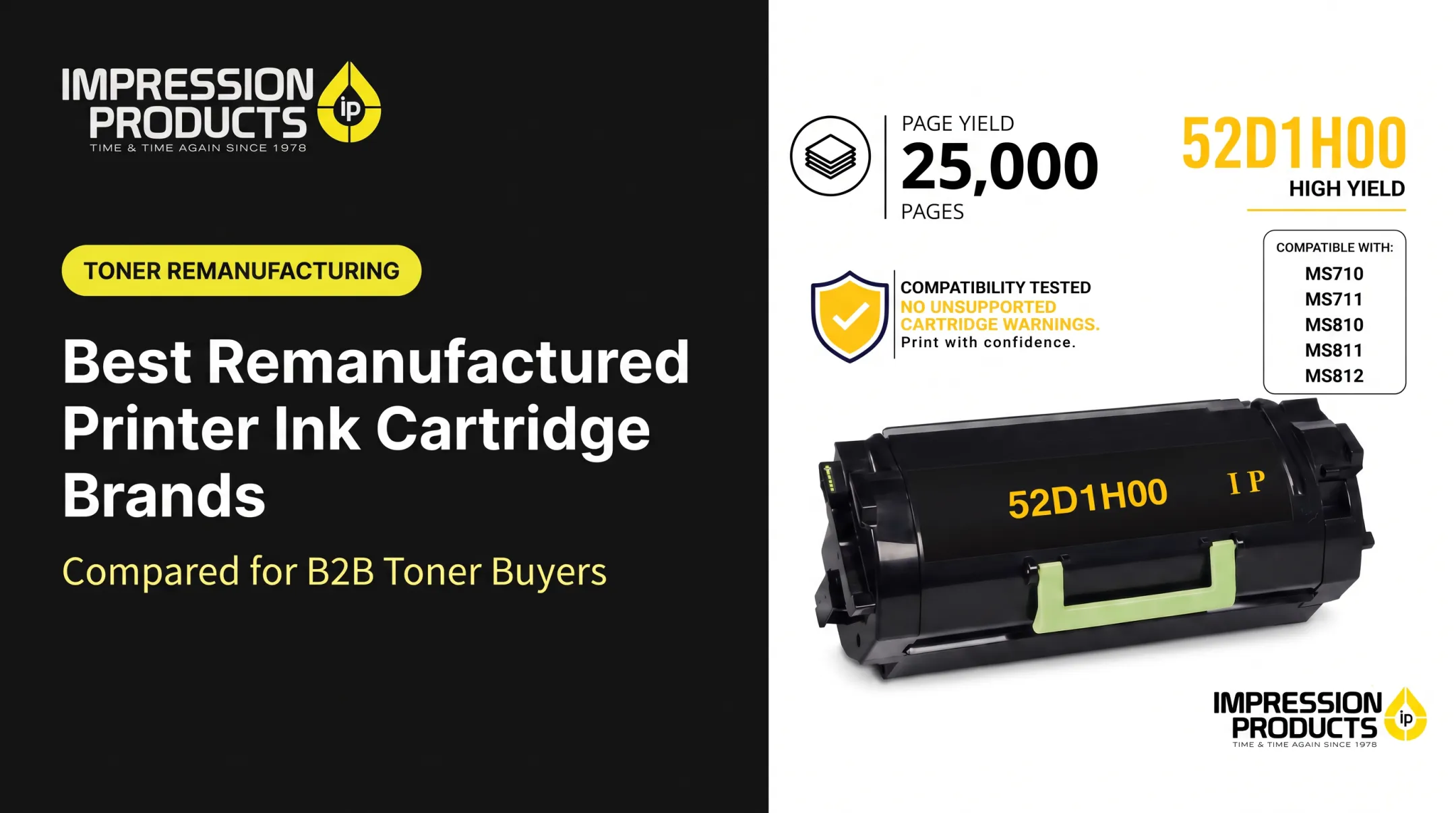
Impression Products has built its remanufacturing process around this reality for nearly 50 years. Cores are cleaned, inspected, rebuilt with new components where needed, refilled, and tested before they ship—giving genuine OEM cartridges a second working life instead of a trip to the trash.
Impression Products also has a legal reason to be confident about reuse. In Impression Products, Inc. v. Lexmark International, Inc. (2017), the U.S. Supreme Court held that a patent is exhausted the moment a cartridge is sold — so Lexmark cannot use patent law to stop anyone from refilling, remanufacturing, or reselling one. Chief Justice John Roberts wrote the opinion, and the Court was unanimous on U.S. sales. Impression Products fought that case for seven years, and the ruling now protects every business that buys aftermarket supplies. Read the full story of the case.
Performance Is a Sustainability Factor
A cheap cartridge that causes reprints, streaking, or premature printer wear isn't actually saving anything. Every reprint burns paper, toner, and time. Look for suppliers who document testing, provide clear composition information, and offer a real warranty or satisfaction guarantee, not just a low price tag.
Comparing Eco-Friendly Toner and Ink Cartridge Options
Toner is a dry powder fused to paper by heat inside a laser printer. Ink is a liquid deposited through an inkjet printhead. Toner tends to suit text-heavy business documents; inkjet suits color graphics and photos. The eco-conscious options differ depending on which technology you're running.
| Option | What It Offers | Watch For |
|---|---|---|
| Remanufactured | Reuses existing shells and components; often strong life-cycle assessment (LCA) results when quality is controlled | Quality control varies by supplier; ask about testing standards |
| New-build compatible | Often lower cost; newly manufactured to fit OEM specs | Not reuse—compatibility doesn't guarantee equivalent environmental performance |
| OEM with take-back | Manufacturer-run collection programs | High collection totals don't equal high remanufacturing rates |
| Refillable tanks | Cuts repeated cartridge purchases for consistent print volumes | Spill risk, maintenance, and bottle packaging still generate waste |
| Bio-based/biodegradable | Emerging formulations exist in research settings | Rarely standard in office cartridges; verify claims before trusting them |
Collection volume is not the same as reuse. One major printer manufacturer's 2024 environmental reporting breaks its own take-back stream down as 24% to reuse plus closed-loop recycling, 60% to open-loop recycling, and 16% to energy recovery. In other words, roughly a quarter of what a headline collection figure covers actually comes back as a cartridge or cartridge-grade material.

A 2021 OEM-commissioned study found newly built compatible toner cartridges had a higher global-warming impact than originals per usable page in that specific test. Sponsored research deserves a careful read, but the finding is a fair reminder that "compatible" describes fit, not footprint. Remanufactured-versus-new and compatible-versus-OEM are separate questions. Results hinge on collection quality, page yield, and the local electricity mix—not on category labels alone.
Ink Formulations: Water-Based, Soy, and Beyond
Water-based, soy-based, and vegetable-based inks show up mostly in commercial and lithographic printing, not standard office inkjet cartridges. A dye-based office ink absorbs into paper fibers; pigment-based ink sits on the surface for sharper, more water-resistant results. Neither formulation alone determines a cartridge's overall footprint, so don't assume "soy" or "water-based" means eco-friendly without checking the actual product documentation.
What to Weigh Before Buying
- Compare cost per page, not only the sticker price
- Match expected page yield to how often you replace cartridges
- Judge print quality for your real mix of text, color, and photos
- Factor in cartridge availability and shipping distance
- Review warranty terms and how transparent the supplier is on testing
How to Choose Eco-Friendly Cartridges for Your Printer
Start with compatibility, not sustainability marketing. Identify:
- Exact printer make, model, and regional model number
- Cartridge part number and color requirements
- Whether your printer uses toner, ink, an imaging unit, or a separate drum
Getting this wrong wastes an entire cartridge before it ever gets used.
Look Past the Sticker Price
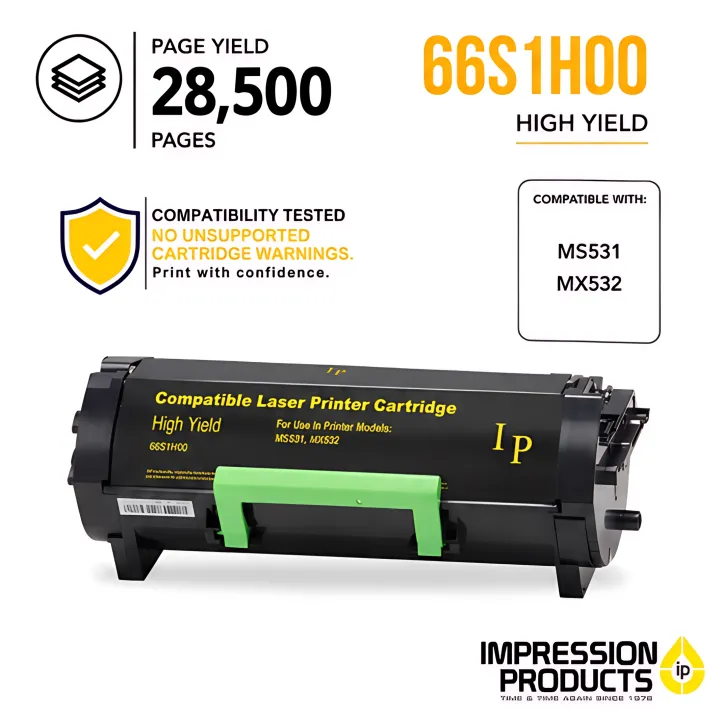
A $50 cartridge rated for 6,000 pages costs more per page than a $215 cartridge rated for 25,000. Impression Products' standard-yield Lexmark cartridges run roughly $50–$80. Extra-high-yield options reach up to 35,000 pages under ISO/IEC 19752 testing and typically save 30–50% versus OEM pricing. Run the actual cost-per-page math before comparing prices.

Vet the Supplier's Quality Controls
Ask suppliers directly:
- Do you inspect and replace worn components during remanufacturing?
- Do you test for chip and firmware compatibility?
- Do you verify density and color consistency before shipping?
- What's your replacement or satisfaction guarantee?
Impression Products tests every compatible and remanufactured cartridge for performance and consistency, backed by a lifetime satisfaction guarantee and U.S.-based support before and after the sale.
Verify Environmental Claims Before You Trust Them
- Ask whether the cartridge is remanufactured, compatible, recycled-content, or refillable—and require a plain definition, not marketing language.
- Check for third-party testing standards, documented material sourcing, and clear take-back information.
- Confirm whether packaging is recyclable and whether the supplier consolidates shipments to cut transport emissions.
Match the Cartridge to Your Operation
- High-volume operations (hotels, pharmacies, dealerships, retail fleets): prioritize yield, steady availability, and automated replenishment.
- Small offices: prioritize exact part-number matching, simple online reordering, and responsive support.
- Sustainability-focused procurement teams: request documentation on domestic manufacturing, recycled content, and collection programs.
If you're standardizing across a fleet and want an American-made compatible or remanufactured option, consider Impression Products for OEM-quality performance, U.S.-based compatibility guidance, and cost-conscious Lexmark pricing. Verify specific product claims against your own testing before you commit at scale.
Before rolling any cartridge out fleet-wide, test it in one representative printer first. Track print quality, actual page yield, failure rate, and total cost over a few weeks. It's a small step that prevents a costly mistake.
Practical Ways to Make Printing More Sustainable
Cartridge choice is one lever. Habits matter too.
- Enable duplex printing by default. Two-sided printing can cut paper use in half on eligible jobs; EPA office guidance reports 30-50% savings in paper costs from duplexing.
- Use draft mode selectively. It's fine for internal drafts, but switch to standard quality for anything that might need a reprint, since a redo wastes more toner than draft mode saves.
- Choose recycled paper carefully. The EPA recommends at least 30% postconsumer fiber for high-speed copier paper. Confirm your printer is rated for the recycled stock you choose.
- Handle empty cartridges responsibly. Use your supplier's return program or an approved drop-off. Most curbside programs, including New York City's, exclude ink and toner cartridges because of mixed plastics, metal, and residual chemicals. Never pour ink or toner down a drain.
- Consider managed print services for multi-printer sites. Remote toner monitoring and automatic replenishment reduce emergency orders and rush shipping. Impression Products offers remote toner inventory monitoring with predictive refill analysis and automatic reorder scheduling for multi-printer organizations.
Frequently Asked Questions
What are some eco-friendly printing inks available?
Water-based, soy-based, and vegetable-based inks exist mostly in commercial and lithographic printing rather than standard office inkjet cartridges. Suitability depends on your printer, the paper or media, and verified product documentation, not the label alone.
What is the most environmentally friendly printer paper?
Recycled paper with at least 30% postconsumer content, or paper from responsibly managed forests, is usually the best choice. Confirm current certifications, recycled content, and that your printer supports the paper's weight and brightness.
What is the most environmentally friendly printer?
It depends on your print volume and use case. Look for energy efficiency, automatic duplexing, compatibility with refillable or returnable supplies, and a reasonable expected lifespan backed by credible certifications.
Are remanufactured toner cartridges better for the environment?
Yes—remanufacturing extends cartridge life and cuts demand for new plastics and materials, so impact is typically lower than making a new cartridge. Real-world results still depend on build quality, collection logistics, and responsible end-of-life handling.
How do I recycle or dispose of toner and ink cartridges responsibly?
Use your manufacturer's or supplier's take-back program or an approved retail drop-off location. Don't place cartridges in household recycling or pour ink or toner down a drain unless local authorities explicitly permit it.