
Introduction
A color laser printer that costs $400 can quietly cost you $2,000 a year in toner. That's the trap: manufacturers price the hardware low and recoup the margin on cyan, magenta, yellow, and black cartridges you'll buy over and over.
Many buyers compare printer sticker prices, or worse, the cost of a single black cartridge, and call it a day. That's not how the math works for color output.
This guide ranks color laser printers using verified cost per page, complete four-cartridge replacement pricing, declared yield, and total ownership factors, not marketing claims.
Every price, yield, and availability figure below reflects a specific check date. Toner pricing shifts often, so confirm current numbers before you buy.
Key Takeaways
- Toner cost per page, not printer price, determines your real operating cost
- Compare all four cartridges (black, cyan, magenta, yellow), plus drums and maintenance kits
- High-yield cartridges can cut cost per page by 39-41% versus standard yield
- Weigh OEM price premiums against compatible and remanufactured savings, testing, yield claims, and warranty
- Match the printer to your actual monthly volume, not just the lowest advertised price
- Impression Products took Lexmark to the U.S. Supreme Court in 2017 and won — the ruling that makes remanufactured Lexmark cartridges legal to buy and sell nationwide
Overview of Color Laser Printers and Toner Costs in the US Market
A color laser printer uses four separate toner cartridges (black, cyan, magenta, and yellow) and fuses the toner onto the page with heat. A monochrome laser only needs one cartridge. Every color page you print draws from four consumables instead of one, so the replacement math gets more complicated fast.
Four Numbers That Actually Matter
Before comparing models, separate these four cost categories:
- Upfront printer cost - what you pay at checkout
- Cartridge replacement cost - price of a full CMYK set
- Cost per page (CPP) - cartridge price divided by declared yield
- Total cost of ownership (TCO) - CPP plus drums, maintenance kits, paper, and downtime
The formula for full-color CPP is straightforward:
CPP = (Black price ÷ Black yield) + (Cyan price ÷ Cyan yield) + (Magenta price ÷ Magenta yield) + (Yellow price ÷ Yellow yield)
Calculate this for every printer you're considering, using both standard and high-yield cartridge options. Don't stop at the black-only number.

Why Declared Yield Isn't a Guarantee
Cartridge yields are tested under controlled conditions, typically at 5% page coverage with continuous printing until the cartridge runs dry. The current benchmark for measuring color toner yield is ISO/IEC 19798, and most major manufacturers reference it in their documentation.
Manufacturers are blunt about this in their own yield documentation: declared yield is an average estimate, not a floor. Dense documents, heavy graphics, and frequent short print jobs all pull actual yield below the lab number. Image-heavy marketing materials will burn through cyan and magenta faster than plain text ever will.
With that framework in place, here's how five common color laser cost profiles stack up on real, verified toner economics.
One more thing worth knowing before you compare cartridge prices: buying non-OEM toner is settled law. In Impression Products, Inc. v. Lexmark International, Inc. (2017), the U.S. Supreme Court held that a patent is exhausted the moment a cartridge is sold — so Lexmark cannot use patent law to stop anyone from refilling, remanufacturing, or reselling one. Chief Justice John Roberts wrote the opinion, and the Court was unanimous on U.S. sales. Impression Products fought that case for seven years, and the ruling now protects every business that buys aftermarket supplies. Read the full story of the case.
Top Color Laser Printers With the Cheapest Toner
Entries one through four each reflect a full four-cartridge cost calculation on a current US-available machine, not a single-cartridge shortcut. Rankings weigh cost per page, cartridge availability, high-yield options, and suitability for typical print volumes. Prices reflect a snapshot as of 2026-09-22 and should be reverified before you purchase. The fifth entry covers the other lever on cost per page: where the cartridge comes from.
1. Compact Color Laser on a Bundled Extra-High-Yield Set
The lowest verified toner-only cost per page among the machines checked came from a compact desktop color laser sold with a bundled four-cartridge extra-high-yield set. The bundle was out of stock at the time of this research, so treat the figure as a price observation rather than a guaranteed buy-now option.
| Metric | Detail |
|---|---|
| Printer price | $429.99 |
| OEM toner set | Extra-high-yield 4-pack, $550.29 |
| Declared yield | 4,500 black / 4,000 color pages |
| Calculated CPP | 13.8 cents/color page |
| Extras | Drum unit included, auto duplex |
Best for: small offices and small teams that need low cost per page without high monthly volume.
The included starter toner (3,000 black / 1,400 color pages) is lower yield than replacement cartridges, so don't use it to estimate ongoing cost.
2. The Multifunction Version of the Same Cartridge Family
The all-in-one sibling of the machine above prints, scans and copies on the exact same extra-high-yield cartridge family. You pay more for the hardware and nothing extra per page.
| Metric | Detail |
|---|---|
| Printer price | $569.99 |
| OEM toner set | Extra-high-yield 4-pack, $550.29 |
| Declared yield | 4,500 black / 4,000 color pages |
| Calculated CPP | 13.8 cents/color page |
| Real-world CPP | 12.3 cents (independent lab testing) |
Independent testing published in December 2023 measured a lower cost per page than the bundle math suggests — a useful reminder that declared yield and observed yield rarely match exactly.
Best for: small businesses that need scan and copy functions with the same low toner costs.
3. Mid-Volume Color Laser With Individually Priced Cartridges
This profile had the cleanest individual-cartridge pricing of anything checked, which is what lets you calculate exact standard-versus-high-yield savings instead of estimating from a bundle.
| Metric | Standard | High-Yield |
|---|---|---|
| Printer price | $529.99 | — |
| Full CMYK set | $566.96 | $1,034.96 |
| Black yield | 2,100 pages | 7,600 pages |
| CMY yield (each) | 1,900 pages | 5,500 pages |
| Calculated CPP | 29.2 cents | 17.7 cents |
Switching to high-yield cartridges cuts cost per page by roughly 39%. Recommended monthly volume is 750 to 4,000 pages.
That range suits small to mid-size offices printing moderate color volume weekly rather than daily.
4. Higher-Duty-Cycle Color Laser With High-Capacity Toner
This platform discloses its testing methodology more clearly than most, stating outright that declared yields assume 5% coverage and vary with image density.
| Metric | Standard | High-Capacity |
|---|---|---|
| Printer price | $649.99 (after rebate) | — |
| Full CMYK set | $523.96 | $950.96 |
| Yield (limiting color) | 1,800 pages | 5,500 pages |
| Calculated CPP | 29.1 cents | 17.3 cents |
With a duty cycle up to 65,000 pages per month and a recommended volume of 6,000 pages monthly, this class targets higher-output environments.
The 41% CPP reduction from standard to high-capacity toner makes the upgrade worthwhile once you print consistently. The higher purchase price and steeper high-yield cartridge cost only pay off if your volume justifies them.
5. Any Color Laser Running a Tested Aftermarket Cartridge Line
The fifth profile isn't a printer at all. Once you've picked a machine, the largest remaining lever on cost per page is the cartridge source, and it moves the number further than switching models usually does.
Compatible and remanufactured cartridges typically land 30–50% below OEM list price for an equivalent declared yield. Applied to the profiles above, that turns a 17-cent color page into something closer to 9–12 cents without changing hardware at all.
The catch is that this only holds when the cartridges are genuinely tested. What to confirm before you switch a fleet over:
- Declared yields measured under ISO/IEC 19798, not estimated
- Chip and firmware compatibility verified for your exact model
- Remanufacturing built on genuine OEM cores rather than unknown shells
- A written guarantee that covers replacement, not just returns
- Consistent availability, so you aren't re-sourcing every quarter
Buyer note: run one cartridge through a representative printer and track actual yield before committing at fleet scale. A supplier that won't support a single-unit trial is telling you something.
The winner for you depends on your monthly page count and document mix. A high-yield cartridge that's a bargain at 4,000 pages a month can sit half-used and dry out at 400 pages a month.

How We Chose the Best Color Laser Printers With Low-Cost Toner
We started with current US-available models, verified exact cartridge compatibility for each, and pulled OEM pricing directly from manufacturer and major retailer listings. Every price and yield figure carries a check date because toner pricing moves constantly.
Calculating Full-Color Operating Cost
We never substituted black-only cost for color cost. Full-color cost per page works like this:
- Take the price of each black, cyan, magenta, and yellow cartridge
- Divide each price by that cartridge’s declared page yield
- Add the four results for total color cost per page
When only bundle pricing was available, we divided the bundle price by the lowest CMY yield. That keeps the estimate conservative, since black cartridges typically outlast color ones.

Comparing OEM, Compatible, and Remanufactured Toner
OEM-commissioned lab testing has reported failure rates as high as 44% across sampled aftermarket cartridges — premature expiry and out-of-box failures being the common complaints — against zero failures among the genuine units in the same sample. Read those studies with the sponsor in mind, but the underlying point stands: "compatible" is a fit description, not a quality standard, and the range between suppliers is enormous.
Quality varies widely by manufacturer. Before you buy on price alone, confirm that a supplier tests for print quality and yield accuracy, remanufactures from genuine OEM cores when possible, and stands behind the cartridge.
Impression Products, a West Virginia remanufacturer in the toner business since 1978, runs those checks on its compatible and remanufactured cartridges and backs every unit with a lifetime satisfaction guarantee.
Total Cost Factors Beyond Toner
Toner is the biggest line item, but not the only one. Also budget for:
- Drums and imaging units, which wear out separately from toner
- Waste-toner containers, common on higher-volume machines
- Maintenance kits, often including fusers, pickup rollers, and separation rollers
- Paper, electricity, shipping, and tax, which add up at higher monthly volumes
- Service calls, especially once a machine is out of warranty
Common Buyer Mistakes
Avoid these when comparing models:
- Choosing the cheapest printer without checking replacement toner cost
- Comparing a standard-yield cartridge against a high-yield one and calling it apples-to-apples
- Pricing only the black cartridge and ignoring cyan, magenta, and yellow
- Assuming a cartridge fits a printer without confirming the exact model number
- Treating declared yield as a guaranteed page count rather than an average
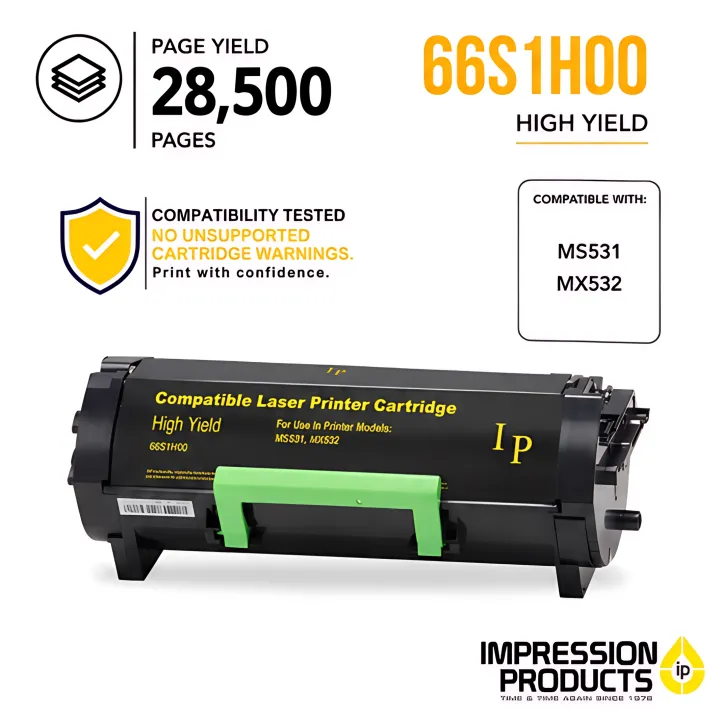
The same cost framework applies if your office runs Lexmark color lasers. Impression Products stocks compatible and remanufactured cartridges across standard, high, and extra-high yield tiers, plus genuine Lexmark imaging kits. Managed print options can monitor toner levels and ship replacements before you run dry.
Conclusion
Look past sticker price. The cheapest color laser printer to operate is the one with the lowest verified total cost per page that still meets your speed, quality, and volume requirements.
Bundled extra-high-yield cartridge families currently post the strongest toner-only numbers. Machines that price each cartridge individually make the standard-versus-high-yield math easiest to verify before you commit. And on any platform, moving to a tested compatible or remanufactured cartridge line is usually the single biggest reduction available to you.
Before you buy:
- Compare the full four-color cartridge set
- Check whether high-yield options make sense for your volume
- Factor in drums, maintenance kits, and purchase price together
If you're managing a fleet of Lexmark printers, Impression Products can help you identify the right compatible toner, imaging unit, maintenance kit, or managed replenishment plan. Call 304-345-3740 or 1-800-642-4359 to keep machines running without the guesswork.
Frequently Asked Questions
How much does toner cost for a color laser printer?
Cost varies by printer model, cartridge yield, and whether you're pricing one cartridge or all four. Always compare cost per page across the complete CMYK set, not the price of a single cartridge.
What is the best brand for replacement toner cartridges?
Match the cartridge to your printer's compatibility needs, print volume, and supply type (OEM, compatible, or remanufactured). Prioritize documented testing, warranty support, and steady availability over brand name alone.
What is the cheapest color laser printer to operate?
The cheapest printer to operate is the one with the lowest verified cost per page across all four toner colors. Calculate that from current cartridge prices and declared yields, not from the lowest purchase price.
Are compatible toner cartridges cheaper than OEM cartridges?
Compatible cartridges are typically priced lower than OEM equivalents, but savings vary by supplier. Check print quality, yield accuracy, return policies, and supplier support rather than choosing on price alone.
Is high-yield toner worth the higher upfront cost?
High-yield toner usually lowers cost per page by about 39–41% based on the models checked here, but it only pays off if you print enough to use the cartridge before it sits idle. Occasional users should compare cost against actual consumption.
What other costs should I consider besides color laser printer toner?
Factor in drums, imaging units, waste-toner containers, maintenance kits, and fusers, plus paper, electricity, shipping, service calls, and the printer's purchase price when you tally total ownership cost.