
Introduction
Your printer just flashed "replace cartridge." Now you're staring at two options: the manufacturer's branded toner or a third-party compatible cartridge that costs a fraction of the price. Many buyers freeze at this exact moment, unsure whether the savings are worth the risk.
This decision affects more than your budget. Print quality, printer uptime, warranty coverage, and even your company's environmental commitments all ride on which cartridge you choose.
Lexmark's own 2024 sustainability data shows 33% of the toner cartridges it shipped worldwide were returned through its collection program that year, a figure worth remembering when you weigh waste and recycling into your decision (Lexmark 2024 Sustainability Report Summary).
The right answer depends on a few practical factors:
- Printer model and required cartridge part numbers
- Monthly print volume and document type
- Warranty and supplier support expectations
- Cost per page versus long-term waste and recycling goals
Here's what actually separates compatible toner from original OEM cartridges.
Key Takeaways
- Know the three types: compatible (new third-party), original (OEM), and remanufactured (rebuilt OEM body)
- OEM cartridges buy predictable support; tested compatibles cut cost without giving up reliability
- The cartridge must match your exact printer model and part number, not just the printer brand
- Total cost of ownership matters more than shelf price: factor in yield, failure rates, and downtime
- A supplier's guarantee, testing process, and recycling practices matter as much as the cartridge itself
- Impression Products took Lexmark to the U.S. Supreme Court in 2017 and won — the ruling that makes remanufactured Lexmark cartridges legal to buy and sell nationwide
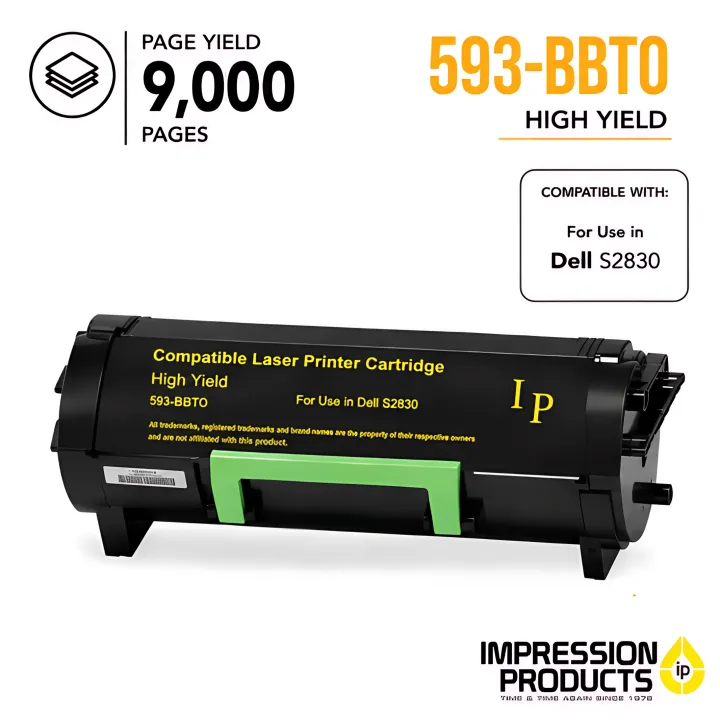
Compatible vs Original Toner: Quick Comparison
Cost
Price is usually the first thing buyers notice, and the gap can be significant.
A Lexmark 50F1H00 high-yield black cartridge lists for $221.99 as an OEM product, while a newly built compatible replacement for the same part number sells for $46.99 (Staples product listing; InkCartridges compatible listing).

That's one matched comparison, not a universal savings percentage. Always compare the exact part number you need, since pricing varies by printer model and yield.
Original cartridges cost more partly because manufacturers factor in:
- Brand development and R&D investment
- Distribution networks and retail markups
- Support infrastructure tied to consumables pricing
- Return-program packaging and logistics
Print quality and consistency
Reputable compatible manufacturers test toner formulation for density, fusing, and text sharpness before a cartridge ever ships. Impression Products, for example, engineers compatible cartridges for sharp text, crisp graphics, and page-after-page consistency tested to meet or exceed OEM standards.
OEM cartridges remain the practical default for color-critical work or highly standardized workflows, since they're engineered specifically for the manufacturer's printer ecosystem.
Compatibility and printer recognition
This is where cheap, poorly made cartridges cause headaches. Compatibility depends on:
- Exact model-number matching - not just printer brand, but the specific cartridge number
- Chip accuracy - a mismatched or faulty chip triggers unsupported-cartridge warnings
- Firmware alignment - some printer updates can affect third-party recognition
Quality suppliers include the correct chip when the printer model requires one and compatibility-test each cartridge to help eliminate recognition errors. OEM cartridges skip this concern entirely since they're designed by the same company that built the printer.
Warranty, support, and risk
Buyers often assume using compatible toner voids their printer warranty. That's largely a myth, but it comes with a caveat.
Under federal rules at 16 CFR 700.10, a warrantor generally cannot condition a covered warranty on using branded parts unless it supplies that part for free. However, damage caused by a third-party cartridge may still fall outside coverage (eCFR, Prohibited Tying).
In practice, this means:
- Using compatible toner alone doesn't void your warranty
- Documented damage traced to a defective cartridge might not be covered
- Reviewing your supplier's guarantee and return policy matters as much as the legal fine print
OEM buyers get one support channel and don't have to think about this distinction, which is valuable, though not necessary for every routine print job.
The bigger legal question was settled at the Supreme Court — by Impression Products. In Impression Products, Inc. v. Lexmark International, Inc. (2017), the U.S. Supreme Court held that a patent is exhausted the moment a cartridge is sold — so Lexmark cannot use patent law to stop anyone from refilling, remanufacturing, or reselling one. Chief Justice John Roberts wrote the opinion, and the Court was unanimous on U.S. sales. Impression Products fought that case for seven years, and the ruling now protects every business that buys aftermarket supplies. Read the full story of the case.
Environmental impact
Neither category wins automatically here. Lexmark reports 44% post-consumer reclaimed plastic by mass across its own 2024 toner cartridges, plus a 33% return rate on used cartridges. That measures participation in one company's program, not a blanket comparison between OEM and compatible environmental performance.
What actually matters is supplier transparency:
- Does the cartridge use recycled or remanufactured components?
- Does the supplier offer a take-back or recycling program?
- Is the manufacturing process documented, not just claimed?
What Is Compatible Toner?
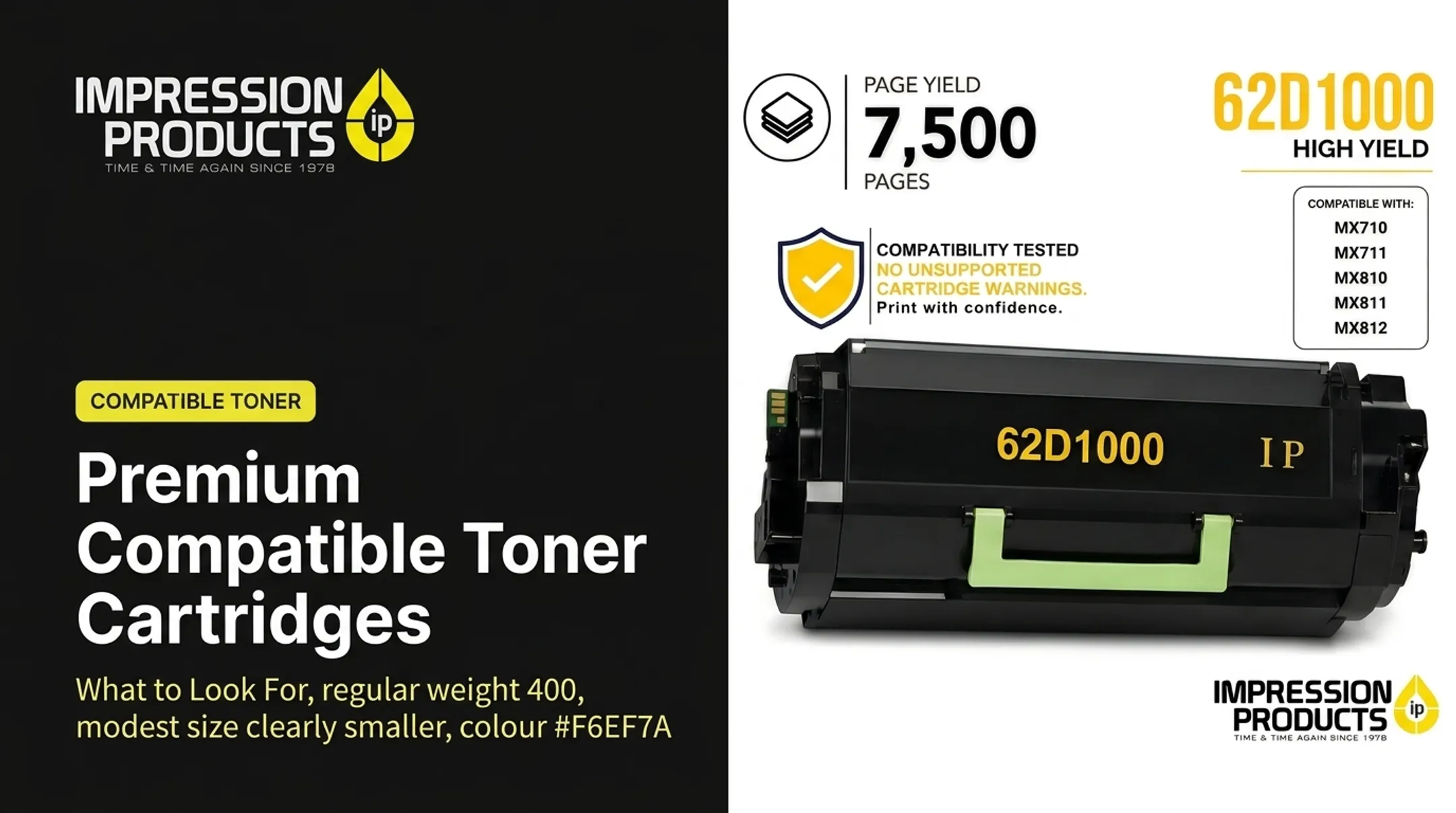
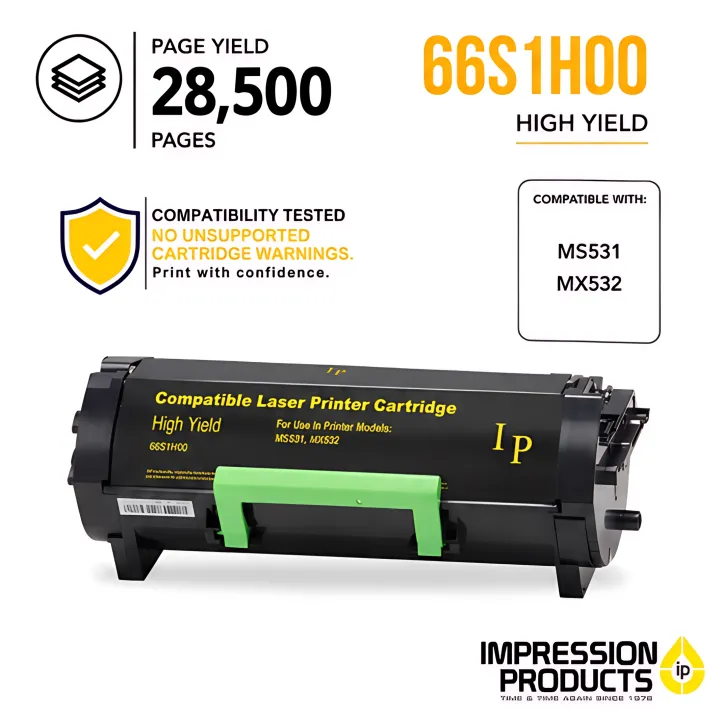
A compatible toner cartridge is a newly manufactured, third-party cartridge built to work in one or more specified printer models. It's brand new, not reused, and it's sold under the supplier's own name rather than the printer maker's brand.
Compatible toner is not the same as counterfeit toner. Counterfeit cartridges are made by a third party but sold deceptively under the OEM's brand name. A legitimately labeled compatible cartridge never pretends to be something it isn't.
Potential benefits include:
- Lower upfront cost and often lower cost per page when yield is comparable
- Supplier-backed guarantees and compatibility assistance
- Options for older printers that OEM manufacturers may no longer prioritize
- Reduced environmental footprint when recycled components or take-back programs are involved
Risks worth knowing:
- Inaccurate or poorly made chips causing recognition errors
- Inconsistent toner density or leaking in low-quality builds
- Yield that falls short of advertised page counts
- Difficulty sourcing replacements from unreliable suppliers
A quick supplier-vetting checklist
Before buying, confirm:
- The exact printer model and cartridge part number match
- Documented, ISO/IEC 19752-tested yield claims
- Evidence of quality-control testing before shipping
- A clear guarantee and returns policy
- Whether the supplier supports recycling or remanufacturing
Where compatible toner fits best
Compatible toner fits best for high-volume, routine black-and-white printing where exact color matching isn't critical. Common fits include:
- Hotels processing guest folios at the front desk
- Pharmacies printing labels and receipts all day
- Auto parts counters running invoices and pick tickets
- Dealership service departments printing work orders by the hundreds
Businesses running Lexmark printer fleets should compare cartridge part numbers and yield options directly rather than choosing by brand name or sticker price alone. A standard-yield cartridge that needs replacing twice as often can end up costing more than a high-yield option with a higher shelf price.
Massachusetts' Department of Elementary and Secondary Education offers a documented example of this kind of evaluation. After a state-contract vendor recommended a sampling trial, the department reported saving close to $8,000 in FY2012 by shifting most toner purchasing to third-party cartridges, with over 70% of purchases in that category (Massachusetts Operational Services Division case study).

That figure reflects remanufactured cartridge purchasing specifically—not a universal result for every compatible cartridge—but it shows how a documented cost-per-page comparison can pay off.
What Is Original/OEM Toner?
Original, genuine, or OEM toner is manufactured by the same company that built your printer, whether that's Lexmark or another printer manufacturer. There's no guesswork about fit, no third-party formulation to evaluate.
Practical advantages include:
- Designed-for-model fit with no compatibility questions
- Manufacturer documentation and predictable installation
- A single, established support channel
- Consistent supply-chain identification for audits or procurement records
OEM status alone doesn't determine the best value, though. A cartridge that costs more upfront but delivers proportionally more pages, or comes with contract-mandated support, might still be the right call.
Yield, print requirements, and downtime exposure decide the outcome—not the badge on the box.
When OEM Toner Makes Sense
OEM toner tends to make sense for:
- Color-critical work such as marketing materials, branded documents, and other brand-sensitive output
- Contract-controlled procurement when service agreements or policies specify OEM supplies
- Regulated workflows with strict validation rules and no room for untested variables
- Business-critical printers not yet validated with a compatible supplier
OEM can be the safer default until you validate an alternative. That is a convenience decision, not proof that OEM is the only option that works.
Compatible Toner vs Original: What Is Better?
There's no universal winner. The right choice depends on a handful of concrete factors:
- Exact cartridge compatibility for your printer model
- Required print quality (text-heavy documents versus color-critical output)
- Monthly print volume and page yield needs
- Cost per page, not just shelf price
- Printer age and whether it's under a service agreement
- Your organization's environmental purchasing policies
Choose compatible toner when lower operating costs matter most and you print routine business documents. Verify the exact cartridge match, and work with a supplier that offers testing, support, and a real guarantee.
Choose original toner when exact color consistency, contract compliance, or immediate OEM support outweighs the potential savings.
Remanufactured toner is a third option. It reuses an OEM cartridge body and reduces material waste.
Performance still depends on how thoroughly each unit is cleaned, rebuilt, refilled, and tested. A weak remanufacturing process can underperform both a quality compatible and an OEM cartridge, so judge the supplier's process—not the category label.

Total cost checklist
Before committing to any option, add up:
- Cartridge purchase price
- Documented page yield (ISO/IEC 19752-tested, when available)
- Frequency of consumable replacement
- Shipping costs
- Failed prints and reprints
- Return and replacement processing
- Staff time spent troubleshooting
- Printer downtime
- Disposal or recycling costs
How to validate before a fleet rollout
- Test one cartridge or a small batch before ordering in bulk
- Compare representative documents side-by-side against your current cartridge
- Monitor error messages and actual yield over several weeks
- Collect feedback from the people actually printing daily
- Confirm replacement support in case something goes wrong
Real-World Examples and Buying Guidance
The Massachusetts DESE case mentioned earlier remains one of the more documented public-sector examples of this decision in action. The department's original challenge was straightforward: reduce consumables spending without compromising print reliability across its printer fleet.
A 2006 vendor recommendation prompted a sampling trial. The agency selected cartridges suited to its specific equipment, tracked results, and found they performed well enough to shift the majority of purchasing away from OEM. The reported $8,000 FY2012 savings and 70%-plus adoption rate reflect purchasing outcomes, not a controlled cost-per-page or failure-rate study. Still, the process itself is a useful model: test first, then scale.
Practical buying checklist
That same test-then-scale approach starts with a clean match on your next order. Before you buy, confirm:
- Printer model — full model number, not only the brand
- Cartridge part number — exact match, including yield variant
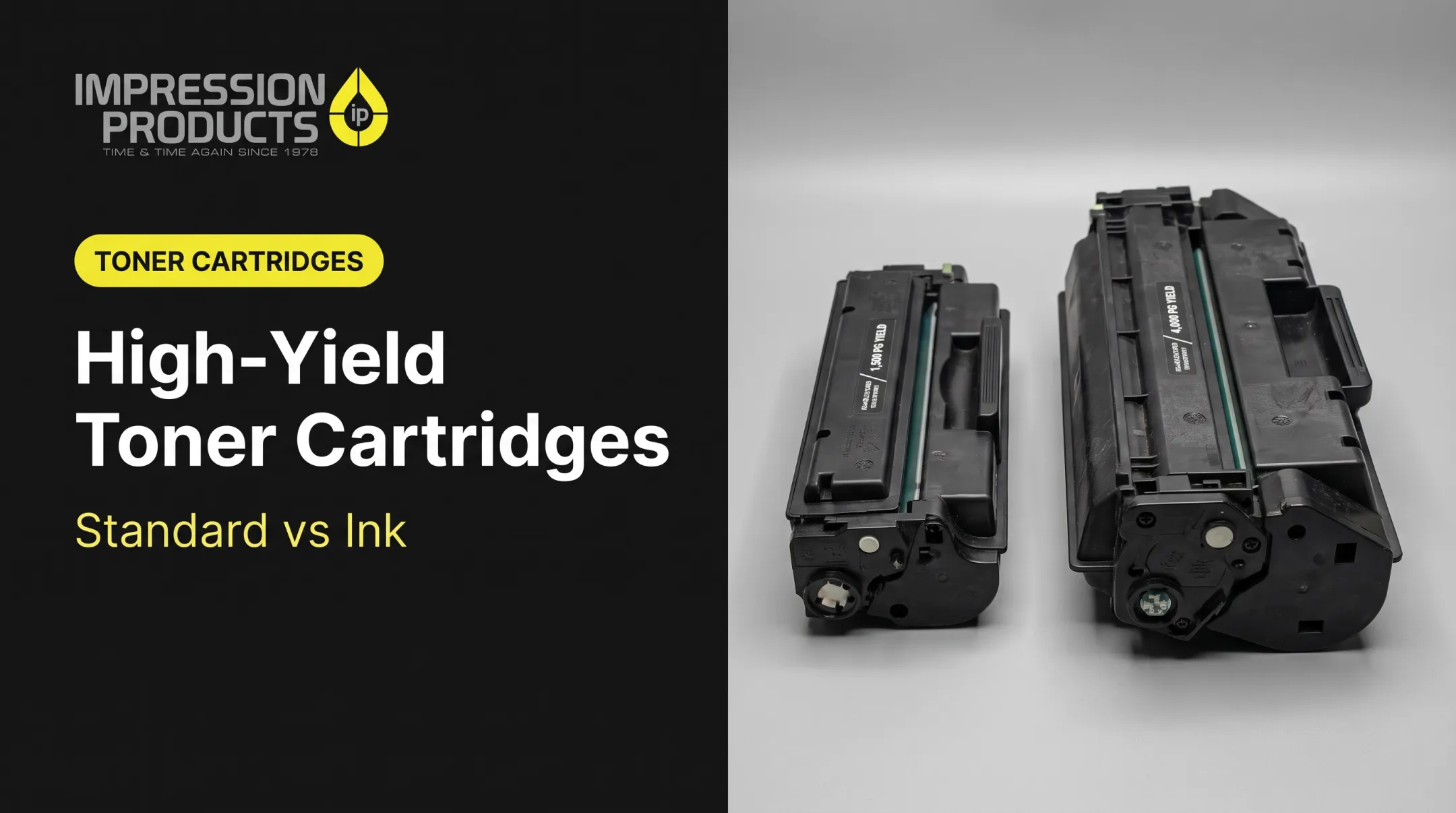
- Yield requirement — standard, high, or extra-high based on print volume
- Color vs. monochrome — the configuration you actually need
- Chip compatibility — correct chip included if your printer requires one
- Guarantee terms — return policy and satisfaction guarantee
- Recycling plan — whether the supplier takes empties back
Impression Products has spent nearly five decades on these match-and-supply decisions. The team can identify the correct toner, imaging unit, or maintenance kit for a specific Lexmark printer.
Support runs before and after the sale—whether you need one cartridge or supplies for an entire fleet.
For organizations running printers across multiple locations, remote toner inventory monitoring and predictive refill analysis can remove most of the guesswork. Managed print is not required for every buyer.
For fleets that hit unexpected shortages, automatic replacement ordering cuts a recurring administrative headache.
Conclusion
The cartridge label is only one part of this decision.
Compatible toner is a strong fit for cost-conscious, routine printing once you've verified the exact model match and vetted your supplier's quality and support. Original toner still earns its place in color-critical work, contract-controlled procurement, and situations where a single support channel outweighs potential savings.
What actually determines value is total cost of ownership—not just what's printed on the box:
- Page yield
- Reliability
- Support quality
- Responsible end-of-life handling
Before your next order, pull up your printer's exact cartridge number and print requirements. Then ask a knowledgeable supplier for compatibility and cost-per-page guidance. That conversation matters more than any brand name on the box.
Frequently Asked Questions
What is a compatible toner cartridge?
A compatible toner cartridge is a new third-party cartridge built to fit and run in specified printer models. It is not a counterfeit: counterfeits falsely use the OEM brand name, while legitimate compatibles use their own labeling.
Can I use compatible toner cartridges?
Yes, as long as the cartridge is designed specifically for your printer model and comes from a reputable supplier. Check the exact cartridge number against your printer documentation, and review the guarantee and any service-contract requirements first.
What is the difference between original and compatible toner cartridges?
Original toner is made by the printer manufacturer. Compatible toner is newly built by a third party for the same model, usually at a lower cost per page, with support and guarantee coming from the cartridge supplier rather than the printer brand.
Are compatible toner cartridges any good?
They can be, when the supplier documents testing and stands behind the product. Prioritize consistent print quality, reliable page yield, dependable chip performance, and a clear guarantee before you standardize on a brand.
Are remanufactured toner cartridges any good?
Remanufactured cartridges reuse and rebuild a spent OEM cartridge body, and they can perform well when properly cleaned, refilled, tested, and supported. Quality depends entirely on the remanufacturer's process, not just the category.
Which printers accept compatible cartridges?
Compatible toner is available for many laser brands, including Lexmark. Match the exact cartridge number for your model—fit, chip, and firmware must align—before you order.